Artists and their Works of Art


Hey y'all! As you might have noticed, I am on an 'art in the classroom' kick. I have been doing an artist of the week in my classroom for the past two years as part of my Daily 6 (your typical Daily 5 literacy centers + a Visual Arts center). My kiddos LOVE this opportunity to be creative. I generally have a print out of an artist's most popular work, a short bio, and materials to replicate their work. Each time I posted a picture of my kiddos final products on social media, teachers asked about it. So, lo and behold... Artists and their Works of Art 


Here is a picture of the cover page:
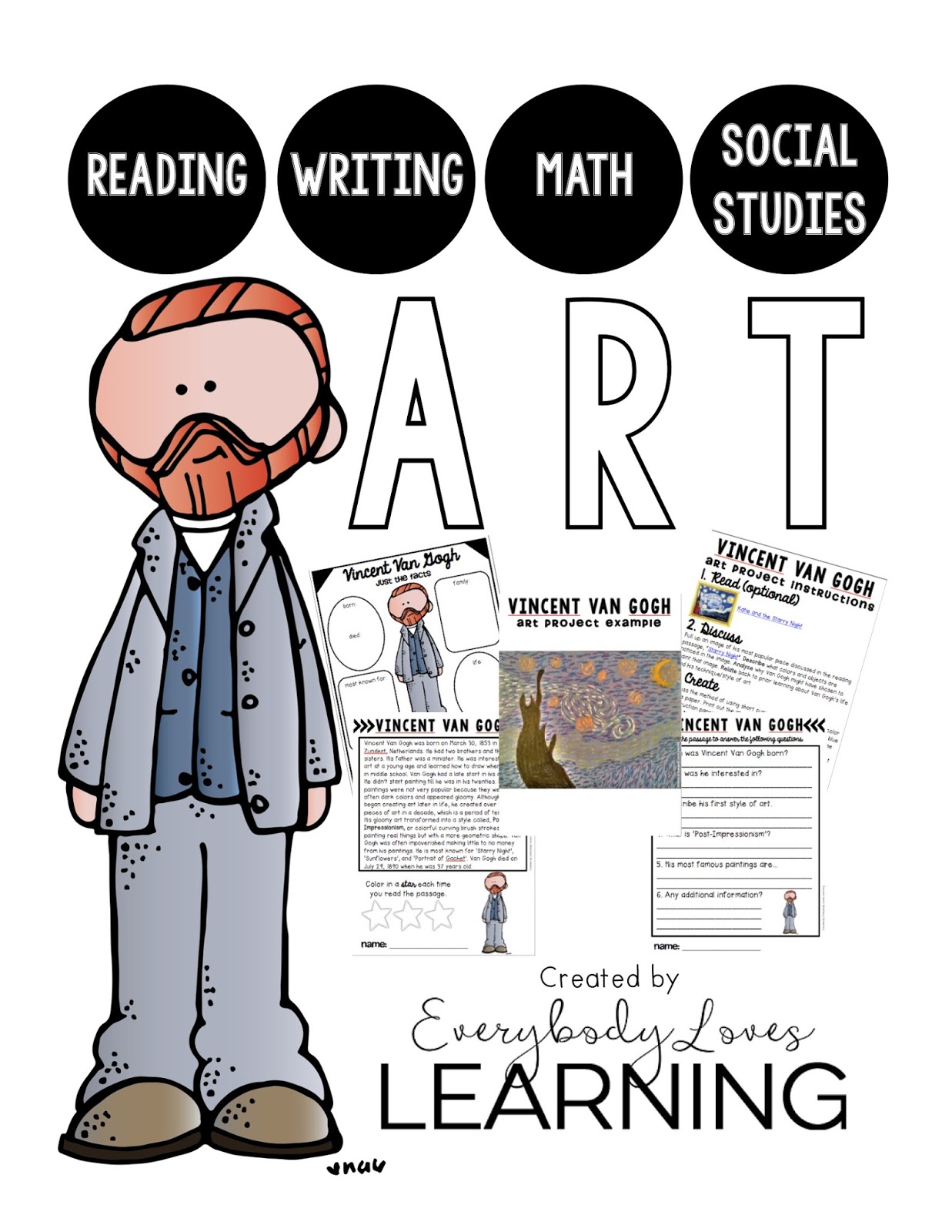
In all honesty, this is my first ORIGINAL IDEA (which are hard to come by nowadays with the Internet, Pinterest, and TPT) for a new resource and I have never been more excited to share something with fellow teachers. This resource includes 14 different artists:
Piet Mondrian
Henri Matisse
Andy Warhol
Keith Haring
George Rodrigue
Pablo Picasso
Claude Monet
Vincent Van Gogh
Georgia O'Keeffe
Jackson Pollock
Edvard Munch
Salvador Dali
Georges Seurat
Faith Ringgold

Would you believe it if I told you I also managed to squeeze in math and social studies?! Well my friends, there are a variety of standards embedded in this language ARTS unit (get it, emphasis on the word arts). 

Here is a preview of the additional handouts:

I could not, for the life of me, figure out how to get my hyperlinks to work after "flattening" and "securing" the PDFs. If you know, please comment below! Also, if you purchase this unit, I want to apologize for the inconvenience and if you don't purchase this unit, here is a list of all of the recommended books about the artists and links to their artists original works of art: 


Painting with Picasso

It seems like many schools are limiting their emphasis on teaching the arts, such as music, art, and theatre. In my opinion, children thrive on learning through the arts. It builds their sense of creativity, imagination, and even their problem solving skills. Fortunately, I work at a campus that takes part in the Creative Learning Initiative (to read more about it see http://www.mindpop.org/creative-classroom/). This initiative is to inspire all teachers to teach using many art forms. It helps promote student engagement, social skills, and overall academic success! Isn't that what we all want?!

I love to start out a lesson with a great story. I read my students Emily's Blue Period by Cathleen Daly. It is a story about a young girl whose parents are separating and how it affects her life. She loves art, especially Picasso, and how his art style of cubism is "mixed up". It describes her emotions of dealing with changes in the home setting in a kid friendly way. The book also describes how Picasso went through a blue period when he was feeling sad and so that is what she does with her artwork. Of course, there's a relatively happy ending as most children's books have :)

After reading, we discuss how her emotions changed throughout the story. We talk about how families are all different. We also talk about the styles of art used in the story, (collage, mixed media, painting, etc.). We look at Picasso's 'The Old Guitarist' and describe what we see, a man, a guitar, he's sitting with his legs crossed on the ground, his head is facing down. Then we analyze the painting, I think he is playing music on the guitar because his hands are on the strings, I notice he is looking down because he might feel sad. Lastly, we relate the image to things that we already know about the subject matter, I think it is in all blue because we learned Picasso went through a blue period, I wonder if Picasso made the man look sad because he was feeling sad. This format provides deep and meaningful discussion, even with my firsties! 

I know that drawing people is hard, hey, I definitely can't draw people! So I modified Picasso's painting of 'The Old Guitarist' into something that both my firsties and I could draw. I gave them big white construction paper and had them do a step-by-step drawing in pencil of a guitar. Next, the students used rulers to create lines through their guitars and the background, modeling Picasso's cubism style. Then, I provided them with blue, white, and black acrylic paints. I gave each student a paper plate that they used to create the shades of blue in their paintings. They had to create a light, medium, and dark shade. They painted their guitars using shades of blue. Once the paintings were dry, the students outlined their original pencil lines in sharpie. The final product looked AMAZING! 

To tie it all together, I had students make a list in their writer's notebooks of things that made them feel sad. Then we shared out ideas as a class and added to our lists in case we forgot something that someone else mentioned. We completed the blue period lesson by writing diamante poems using nouns, adjectives, and verbs. The best part is that not a single student was disengaged during this lesson! PLEASE, PLEASE, PLEASE, keep teaching art in your classrooms! Especially since it is so easy to tie in to academics!

Really Good Research

Expository writing is a skill that students use throughout their academic life and sometimes into their careers. I teach my first graders how to thoroughly research topics of interest. First, I take an inventory of what the students are interested in. Once I have a few options, I look into what state standards I can tie in and what is on our scope and sequence at the time of the project. Another thing I look at are what resources I have available.

This year my kiddos are REALLY interested in animals. So choosing to research habitats was a no brainer! It ties in adaptations, environments, life cycles, food chain, predators and prey, plants, flowers, non-living things, and so much more!

Before we ever started, we spent about two weeks learning how to write a topic sentence using Christine Statzel's unit "Write Right Part One" I swear by this unit! My kiddos really gain the skill of hooking their reader and making sure their sentences are all on topic.

I write each habitat I plan on having my students study on the white board and let students write their names under their number one pick. I limit them by saying only 4 students per habitat. Once I have grouped my students based on their habitat interests, I provide them with an abundance of books from the library. Most of these books are way beyond my first graders reading levels, so I modeled how to look at pictures and photo captions as a primary source of gathering information. Keeping in mind the standards to I want to teach, I instructed my students to look for the weather, plants, and animals that live in their habitats. They were able to work in groups and write their information on a white board. Each child had a job whether they were in charge of writing, finding information, material manager, etc.

Here are some of the desert group members:

Here's what the pre-research looks like:

After the groups have collected research from books and have written the main ideas down on the white board, I provide each student with a habitat graphic organizer from Miss Hellen's Hippos unit "Habitats and Landforms for the Beginner". This is to make sure each child is held accountable for the information gathered and so they have all of their information at hand for the next step.

Here is a picture of the unit:

Once each child has their graphic organizer completed, we start the writing process. The first day I only have them write their topic sentence. I do this for a few reasons, research can be stressful and overwhelming so the more spread out it is, the better, and because I am expecting really good sentences so if they only are writing one, they know it must be their best. The next day, I have them draw and label their details (relating it back to their picture research using one detail about the weather, one about an animal that lives there, and one about a plant that lives there). The last step is to write their supporting details using Christine Statzel's "Wright Right Part Three".

This is an example of a student's rough draft:

Since this is one of our published pieces of writing, I edited their rough drafts. I modeled how I wanted them to write their finals drafts. Once their final drafts were completed, we had a mini-lesson to learn how to write a conclusion sentence that relates back to our topic sentence. Next time, I will make their final draft paper with a thinner line thickness! My kiddos kept saying that looking at the paper was making them dizzy... Whoops! 

This is an example of a student's final draft:

The last step of this project was to make a triorama. I can not tell you enough how much I LOVE trioramas. This was a two-day activity. The first day we made the habitat's plants and depicted the weather. They were not allowed to draw any animals this day. The second day the were able to choose 2-3 animals they wanted to replicate. I had printed a variety of animals that live in each habitat the students were studying. The hardest part of the project was making the animals pop up! I personally made more than 60 little squares to tape on to the backs of each animal... If y'all know an easier way please let me know! Last year, I used popsicle sticks, but they stuck out from the bottom of the trioramas and it didn't look as nice. It's a learning process! Hopefully, I find something more efficient than this! Needless to say, they turned out so stinking cute!! 

This is an example of a student's triorama:

Primary Reading Assessments

In December 2015 the US Department of Education passed a law that did away with No Child Left Behind (NCLB) and passed Every Student Succeeds Act (ESSA) and left all remaining aspects up the the states. If you weren't aware, NCLB had many criticisms because it expected teachers to spend more time on testing than on teaching. The Act only focused on students who were academically below average and didn't consider the students who might be above average. It was developed to close the achievement gap and many provisions were made throughout the 14 years of its' existence. ESSA is a similar act but it places more accountability on the states. This is where it gets interesting.

Since I started teaching in Texas, I have been required to test students using two primary reading assessments, Texas Primary Reading Inventory (TPRI) and Developmental Reading Assessment (DRA) at the beginning, middle, and end of each academic year. I know all educators love acronyms, right? ;) After my district became aware of the changes in the educational act, our reading assessment requirements have changed. We are now only required to administer the TPRI at the beginning, middle and end, and the DRA only at the beginning of each year.


We held a campus-wide discussion to decide whether or not we were still going to administer the DRA in the middle and end of each year. As with anything of importance, there are a wide range of opinions. Many teachers aren't planning on administering more than the required beginning of the year test because ESSA is trying to cut down time spent testing and allow more time to teach. Other teachers are going to give the reading assessment all throughout the year but agree that not having deadlines is a nice weight off their shoulders.

Honestly, I have a split opinion. Who wouldn't want the opportunity to spend less time sitting at a kidney table testing individual students, recording results, and collecting and entering data? I love the fact our district is choosing to give us back that valuable teaching time. Hey, every minute in our day counts. But on the other hand, my entire classroom library is leveled based on DRA levels. Part of me feels that finding out the student's reading level is crucial to selecting the right books for them to read independently.

So, here I am writing this blog post seeing what y'all think about these changes?

First Time Blogger

Hey y'all! I am a third year teacher in the great state of Texas. I teach first grade and love my job more than humanly possible. As you all know, we get summers off. Well, in my case it leads to boredom. I start my summers off writing curriculum for the district. Unfortunately, this "supplemental job" only lasts about two weeks. After that, there are at least 6-8 more weeks off! Yes, I know we are given this time to recharge, relax, and unwind but I'm simply not that type of person. I am quite "Type A", as most teachers are, and I need something to fill my time in the summers.


I decided that Teachers Pay Teachers would be a great time filler. Besides the fact that it is an online marketplace that teachers have collectively sold millions and the potential to earn a supplementary income, that is exactly what it is. I spent hours researching how to copyright, secure PDFs, design products, clipart and font license terms of use, setting up a store, formatting a banner and a quote image, etc. The list of learning goes on and on. I set up my store titled, "Love at First site" because I love puns. I wanted people to fall in love with my webSITE. Little did I know how many people misuse the word site meaning to use the word sight. This misunderstanding set me back in my branding as far as keeping my social media sites consistently named. So, I changed it! Renaming a brand/blog/TPT page is quite challenging... Now I am backtracking to ensure everything is named properly and linked accordingly.


It has been about 6 months since I opened up my store and have learned so much throughout this whole process. I have always considered myself a lifelong learner which is why one of my New Year's resolutions was to start a blog. Creating an account was tough, but hey, I learned how to make a post today! Baby steps. I hope y'all stick with me as I learn along the way.

Click the social media buttons on the right side to learn more about me and my interests.

Thanks for reading!